What is Ki
In East Asian medicine, we believe that Ki resides in all things. Ki is the vital energy that animates every living creature, including human beings. We also believe that a spirit dwells in everything around us—mountains, rivers, even stones. Each person has their own Ki, the energy that sustains their life. Within the body, there is also Ki specific to each organ—Liver Ki, Kidney Ki, and others—as well as Ki that powers our essential functions, like breathing and immunity. From the largest scale to the smallest, Ki is present everywhere. The word is written 気 and pronounced Ki in Japanese, Qi in Chinese.
We assess the body by reading the state of its Ki. Consider an 80-year-old woman who comes in with pain. Her shoulders and neck ache, though she hasn’t done anything in particular to cause it—the pain is dull and lingering. She has been losing weight and isn’t eating well. In her case, the body is lacking Ki, and it is this deficiency that produces her pain.
Now consider a younger man with a demanding, stressful job. His shoulders and neck are tight and painful. His body is not lacking Ki—instead, his Ki is stuck, and it is this stagnation that gives rise to his pain.
We treat based on what we find. When Ki is insufficient, we replenish it, and the pain resolves. When Ki is stuck, we move it, and the pain resolves.
Ki 気
Ki is fundamental substance that drives the workings of the internal organs and form the very basis of life.
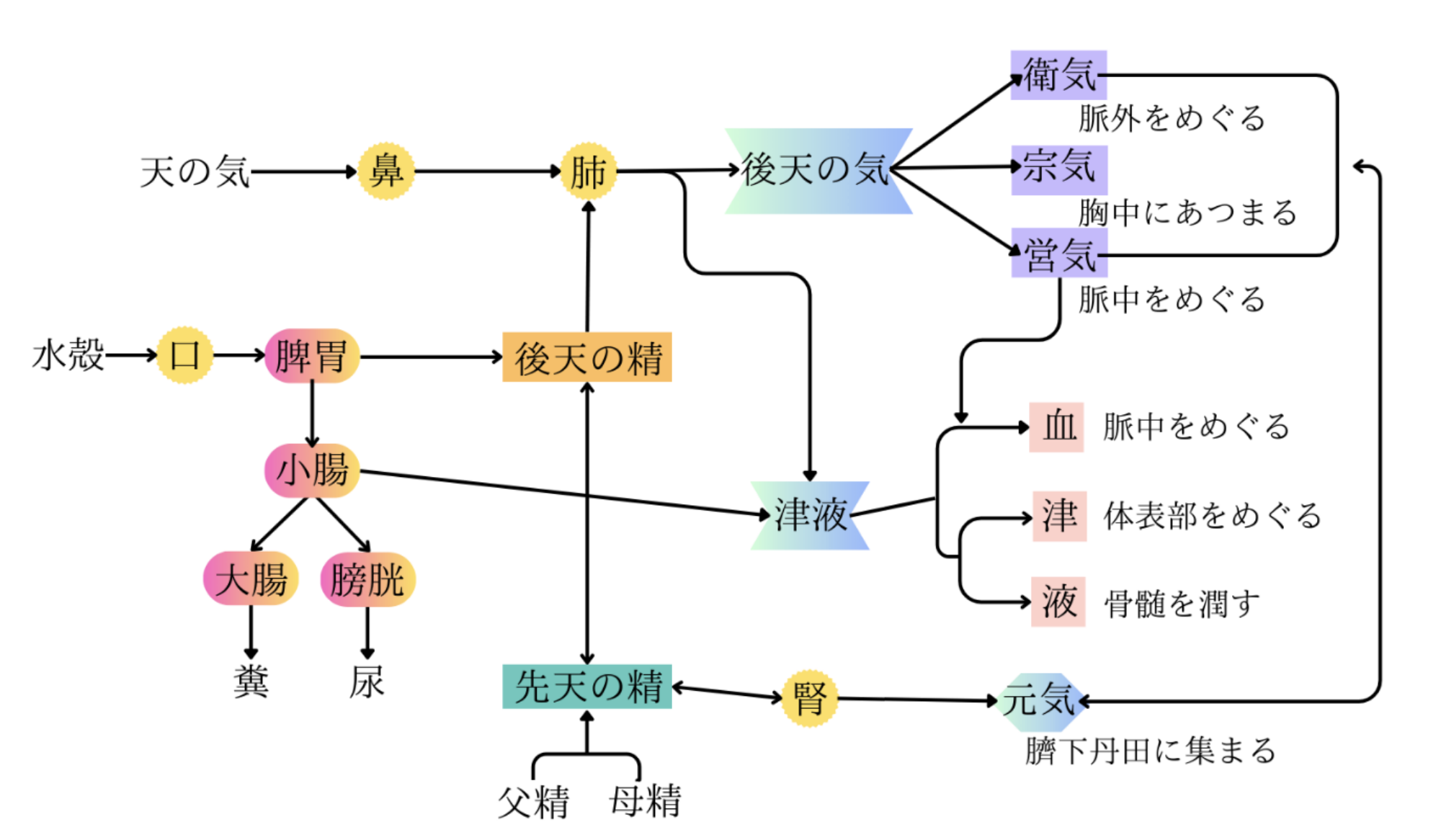
How did the doctors of ancient East Asia explain Ki to their patients? They taught that the body draws its Ki from three sources. The first is the Ki you inherited from your parents at birth—the Ki you were born with. The second is the Ki you take in with every breath. The third is the Ki you draw from the food you eat and digest.